
9 Signs of Bad Car Battery You Shouldn’t Ignore
A car that will not start at home before school drop-off or after a long day at work is more than an inconvenience. Knowing the signs of bad car battery can help you act before you are left stranded in a car park, driveway or at the side of the road. Batteries often weaken gradually, but the warning signs can be easy to dismiss until the vehicle finally refuses to start.
For drivers around Ringwood and Melbourne’s eastern suburbs, a professional battery test is a straightforward way to understand whether the battery is still reliable, whether the charging system needs attention, or whether another fault is causing the problem. Here are the warning signs worth taking seriously.
1. The engine cranks slowly
A slow or laboured crank is one of the clearest signs that a battery is losing its ability to provide enough starting power. When you turn the key or press the start button, the engine may sound as though it is struggling to turn over before it eventually starts.
This may be more noticeable on cold mornings, when a weak battery has less available power. One slow start does not always mean the battery has failed, especially if the car has been sitting unused. However, if it happens repeatedly, it is sensible to have the battery and charging system checked rather than waiting for a no-start situation.
2. Your car needs a jump-start
A vehicle that needs a jump-start has a battery that is either discharged, failing, or not being properly recharged while driving. A jump-start can get you moving, but it should not be treated as a long-term fix.
Sometimes the cause is simple, such as interior lights being left on or a door not fully closed. In other cases, the battery can no longer hold sufficient charge, the alternator may not be charging correctly, or an electrical component may be drawing power while the car is parked. Accurate diagnosis matters because replacing a battery alone will not solve an underlying charging or electrical issue.
3. Headlights and electrical features seem weak
Dimming headlights, particularly at idle, can point to low battery voltage or a charging system concern. You may also notice that the cabin lights look dull, power windows move more slowly than usual, or the infotainment screen takes longer to start.
Modern vehicles rely heavily on stable electrical power. A weak battery can affect systems you would not immediately connect with starting the car, including central locking, stop-start operation, parking sensors and warning displays. These symptoms can also relate to an alternator fault, so a proper test is more useful than guessing.
4. Warning lights appear unexpectedly
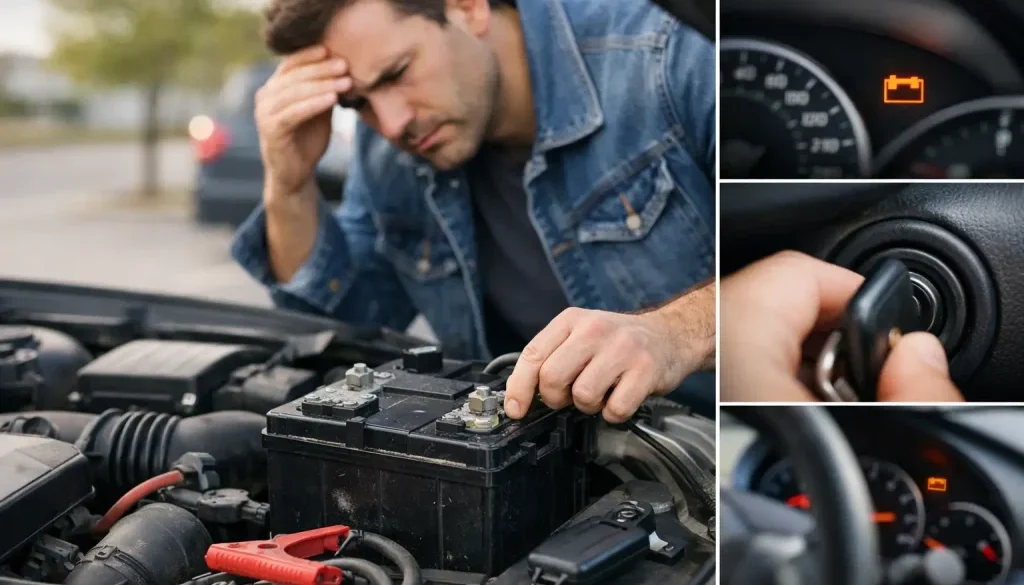
An illuminated battery warning light should always be taken seriously. Despite its name, this light commonly relates to the vehicle’s charging system rather than the battery itself. It can indicate that the alternator is not supplying enough charge, a belt or wiring issue is present, or there is a fault in the electrical system.
Other warning lights may also appear when voltage is low, especially in vehicles with numerous electronic control modules. If warning lights appear alongside slow starting, flickering lights or unusual electrical behaviour, arrange an inspection promptly. Continuing to drive with a charging fault can eventually leave the vehicle unable to restart.
5. The battery case looks swollen, cracked or corroded
A visual check can reveal obvious warning signs. Battery terminals may develop white, blue or greenish corrosion, which can interfere with the connection and reduce the flow of electrical power. A damaged, swollen or leaking battery case needs professional attention as soon as practical.
Heat is particularly hard on car batteries. Under-bonnet temperatures during Melbourne summers can accelerate internal wear, while repeated short trips may not allow the battery enough time to recover its charge. If the battery looks physically damaged, do not ignore it or attempt to keep using it as normal.
6. The battery is getting older
Many car batteries last several years, but their actual service life depends on the vehicle, climate, driving habits and battery type. A battery fitted years ago may still start the car today, yet have little reserve capacity left for the next cold morning or a busy week of short trips.
If you cannot remember when the battery was replaced, it is worth asking for its condition to be checked at your next service. This is especially worthwhile before a road trip, during winter, or if your vehicle has stop-start technology, which places greater demands on the battery.
7. Stop-start no longer operates consistently
In cars equipped with stop-start, the system may stop working when battery charge or health falls below the level required for reliable restarting. The vehicle may still drive normally, so it is easy to assume nothing is wrong.
There are other reasons stop-start may be temporarily unavailable, including a cold engine, air conditioning demand or certain driving conditions. But when the feature remains unavailable for an extended period, a battery health and charging-system assessment can identify whether the battery is contributing to the issue.
8. You notice a clicking sound but the engine will not start
Rapid clicking when attempting to start the car commonly occurs when there is not enough battery power to engage the starter motor. A single click can also indicate a starter-related issue, so the sound alone cannot confirm the cause.
The key point is that the vehicle needs a diagnosis rather than repeated start attempts. Persistently trying to start a vehicle with a weak battery can further drain it and may make it more difficult to determine what caused the original fault.
9. Electrical problems occur after the car has been parked
If your car starts and runs normally after a longer drive but struggles again after sitting overnight or over a weekend, the battery may not be holding charge. This pattern can also suggest an electrical draw when the vehicle is switched off.
A professional test can assess battery condition, charging performance and whether the vehicle is losing power while parked. This is particularly useful for vehicles with aftermarket accessories, infrequent use, or complex electrical systems. European vehicles and newer models can be sensitive to low voltage, sometimes producing multiple alerts that disappear once the power supply is restored.
What causes a car battery to fail?
Age is the most common cause, but battery failure is rarely just about the calendar. Frequent short journeys, long periods without driving, heat exposure, loose connections and charging-system faults can all reduce battery life. A battery can also lose capacity after being deeply discharged.
There is a trade-off with modern vehicle technology. Extra safety, comfort and connectivity features add convenience, but they also place more demand on the electrical system. That is why the right battery specification and correct installation are important, particularly for vehicles with stop-start systems or battery management sensors.
When to arrange a professional battery check
Do not wait until the car is completely flat if you have noticed slow cranking, warning lights, recurring jump-starts or erratic electrical features. A workshop can test the battery under load, inspect terminal condition and confirm that the alternator is charging as it should. This separates a tired battery from faults that need a different repair.
At Ringwood Auto Tech, battery concerns are assessed as part of practical, vehicle-specific care, with clear advice on the condition of your car and the work it needs. Addressing a weak battery early helps protect your routine, your vehicle’s electrical systems and your peace of mind.
A reliable start should never be something you have to hope for. If your car is giving you early warnings, having it checked now is the simplest way to keep tomorrow’s plans on track.