

Transmission Diagnosis Example: What Tests Reveal
A transmission concern can feel alarming because the symptoms often arrive without much warning: a hesitation pulling away from the lights, a hard shift on the school run, or a warning message that disappears after the car is switched off. This transmission diagnosis example shows why the right answer rarely comes from one symptom alone. A thorough assessment looks at the vehicle, its history and the conditions that reproduce the fault before any repair is recommended.
For drivers in Ringwood and Melbourne’s eastern suburbs, that process matters. Modern automatic, DSG, dual-clutch and S-Tronic transmissions rely on mechanical components, hydraulic pressure, electronics and software working together. A fault in one area can feel exactly like a problem in another.
A transmission diagnosis example from first symptom to answer
Consider a late-model European vehicle with a seven-speed dual-clutch transmission. The owner notices a shudder when moving away from a stop, followed by an occasional delay selecting reverse. There is no warning light every time, and the vehicle drives normally once it is moving at suburban speeds.
It would be easy to assume the clutch assembly is worn. It may be, but that conclusion cannot be made responsibly from the shudder alone. Similar symptoms can be caused by incorrect transmission fluid condition or level, a mechatronic control issue, adaptation values outside their normal range, engine performance concerns, a driveline mount issue or software-related faults. The aim of diagnosis is to separate possibilities from evidence.
The technician first confirms the customer’s description. When does the shudder occur? Is the vehicle cold or fully warmed up? Does it happen on a hill, after stop-start traffic, or when reverse is selected after a longer drive? Details such as these help establish a pattern. They also prevent a workshop from chasing a fault that cannot be duplicated.
A road test is then performed where appropriate and safe. The technician listens and feels for the concern while monitoring how the transmission responds. In this example, the shudder is most noticeable during a gentle take-off once the vehicle reaches normal operating temperature. Reverse also engages slowly on two occasions.
What a professional transmission diagnosis checks
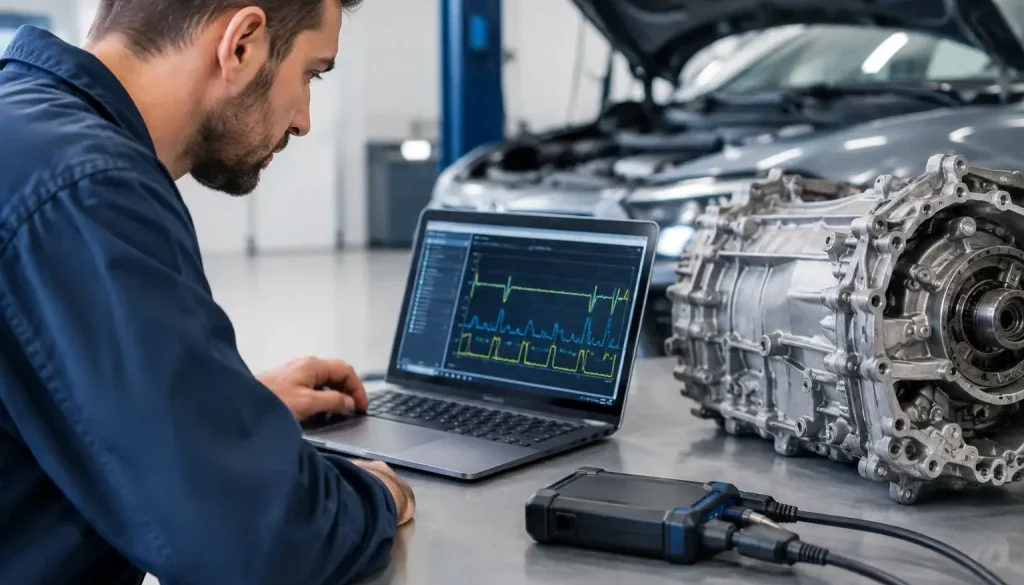
After the initial assessment, diagnostic equipment is connected to scan the vehicle’s control modules. This does more than check for a dashboard warning light. Modern vehicles can store fault codes, temperature data, clutch adaptation figures, pressure readings and event information that may not be visible to the driver.
In this case, the scan identifies an intermittent transmission-related fault code and adaptation values that are approaching their limits. That information is useful, but it is not a repair verdict by itself. A stored code tells a technician where to investigate, not always which component must be replaced.
The next stage is a careful inspection. The technician checks for external leaks, damaged wiring or connectors, signs of fluid contamination, and any relevant issues around the engine and driveline. Transmission fluid is assessed against the manufacturer’s requirements. On many systems, both the correct fluid specification and temperature-controlled filling procedure are critical. Using the wrong fluid, or making assumptions about fluid level, can create further problems rather than solve the original one.
The vehicle’s service history is also considered. Some automatic and DSG transmissions have specific fluid and filter service requirements. If a scheduled service has been missed, fluid deterioration may affect shift quality and internal operation. However, servicing is not a cure-all. If testing points to an internal clutch, mechatronic or mechanical fault, a fluid service alone will not resolve it.
In this example, the inspection finds no leak or wiring damage. The transmission fluid service is overdue, but the data and road-test results indicate that the concern is more than routine maintenance. Further guided testing confirms inconsistent clutch control within the transmission system.
Turning test results into a practical recommendation
At this point, a good workshop should explain the findings in plain language. The customer needs to know what has been confirmed, what remains possible and what the recommended next step is. Technical terms are useful when they clarify the issue, not when they make the process harder to understand.
For this vehicle, the findings suggest wear or control concerns affecting clutch engagement, with the mechatronic unit requiring close assessment as part of the repair plan. Depending on the transmission type and exact test results, the appropriate work may involve servicing, mechatronic repair, clutch replacement, internal transmission repair or a combination of these. The correct option depends on evidence, vehicle condition and the manufacturer’s procedures.
That is the value of diagnosis. Rather than replacing parts based on a common symptom, the technician can provide a targeted recommendation that addresses the actual cause. It helps protect the vehicle from unnecessary work and gives the owner a clearer path forward.
Why transmission symptoms can be misleading
Transmission faults do not always present as obvious gear-change problems. A vehicle may surge, vibrate, flare between gears, hesitate when selecting drive or reverse, or enter a reduced-performance mode. Some drivers notice a burning smell or fluid leak. Others only notice that the vehicle is behaving differently in heavy traffic or when climbing a hill.
There can also be overlap with other systems. An engine misfire, worn engine mount, battery voltage issue or driveline fault may be felt as a harsh shift or vibration. Likewise, a genuine transmission fault may appear only under a particular load or temperature. This is why a quick scan without inspection and road testing can leave important questions unanswered.
Early attention is usually the sensible approach. Continuing to drive with a shudder, delayed engagement or warning message can allow a small concern to develop into a more significant one. That does not mean every symptom requires major transmission work. It means the vehicle deserves an accurate assessment before the problem becomes harder to diagnose or affects reliability.
What to tell your transmission specialist
Clear information helps make the diagnostic process more efficient. When booking in, describe whether the fault occurs when the vehicle is cold, after warming up, during acceleration, in stop-start traffic or when selecting reverse. Mention any warning lights, messages, unusual noises or fluid marks where the car is parked.
It is also helpful to explain whether the issue started suddenly or gradually, and whether recent servicing or repairs were completed. If the concern is intermittent, avoid clearing warning messages or disconnecting the battery before the inspection unless advised. Stored information can assist the technician in tracing a fault that is not active at the workshop.
Drivers should not feel they need to diagnose the vehicle themselves. Your role is simply to describe what you have experienced as accurately as you can. A professional technician will take care of the testing, interpretation and repair planning.
Specialist care for DSG and automatic transmissions
Dual-clutch and automatic transmission systems have become increasingly sophisticated, particularly across European vehicles. They need the correct diagnostic equipment, service information and practical experience to assess properly. Generic assumptions can be costly when a vehicle has specific fluid, calibration or component requirements.
Ringwood Auto Tech approaches transmission concerns with that level of care, treating each vehicle as though it were our own. Whether the result is a scheduled DSG service, further mechatronic testing or a repair plan for an internal fault, customers should receive straightforward advice and a recommendation based on the condition of their vehicle.
If your car is shuddering, delaying engagement, changing gears harshly or showing a transmission warning, make a note of when it happens and arrange an inspection. A clear diagnosis provides more than an answer – it gives you confidence that the next decision is being made with your safety, reliability and peace of mind in mind.