Automatic Transmission Repair: Signs to Act
A hesitation as you pull away from the lights, a hard shift on the way to work, or a warning light that appears without explanation can quickly turn an ordinary drive into a concern. Automatic transmission repair is not something to put off, particularly when your vehicle carries the family, gets you to work or supports your business. Early assessment can help identify the cause before a small drivability issue becomes a more involved repair.
Modern automatic transmissions are sophisticated systems. They combine mechanical components, hydraulic pressure, fluid, electronics and computer control to select gears smoothly and efficiently. DSG, dual-clutch, DCT and S-Tronic systems add another layer of precision. The right repair begins with understanding exactly what the vehicle is doing and why.
Signs Your Car May Need Automatic Transmission Repair
Not every unusual shift means the transmission has failed. A low battery, engine fault, sensor issue or software concern can sometimes create similar symptoms. However, changes in the way your car drives deserve professional attention, especially if they become more frequent.
A delay when selecting Drive or Reverse is one common warning sign. You may select a gear, release the brake and notice a pause before the vehicle moves. Harsh engagement, jolting between gears, slipping under acceleration or a feeling that the engine revs without the expected forward movement should also be checked.
Pay attention to noises as well. Whining, humming, clunking or grinding that appears during gear changes is not normal wear to ignore. Some drivers also notice shuddering at low speed, while manoeuvring, or when the vehicle is climbing a hill. In a dual-clutch vehicle, this can point to a range of concerns involving clutch operation, adaptation, fluid condition or the mechatronic control system.
A transmission or check-engine warning light is an equally clear reason to arrange diagnostics. Even if the car still drives, the control unit may have stored fault information that helps a technician find the issue before performance or reliability is affected further.
Why Accurate Diagnosis Matters
Transmission symptoms often overlap. For example, a rough shift may be caused by degraded fluid, a valve body issue, an electrical fault, worn internal components, a clutch concern or a problem outside the transmission itself. Replacing parts based on a symptom alone is rarely the sensible approach.
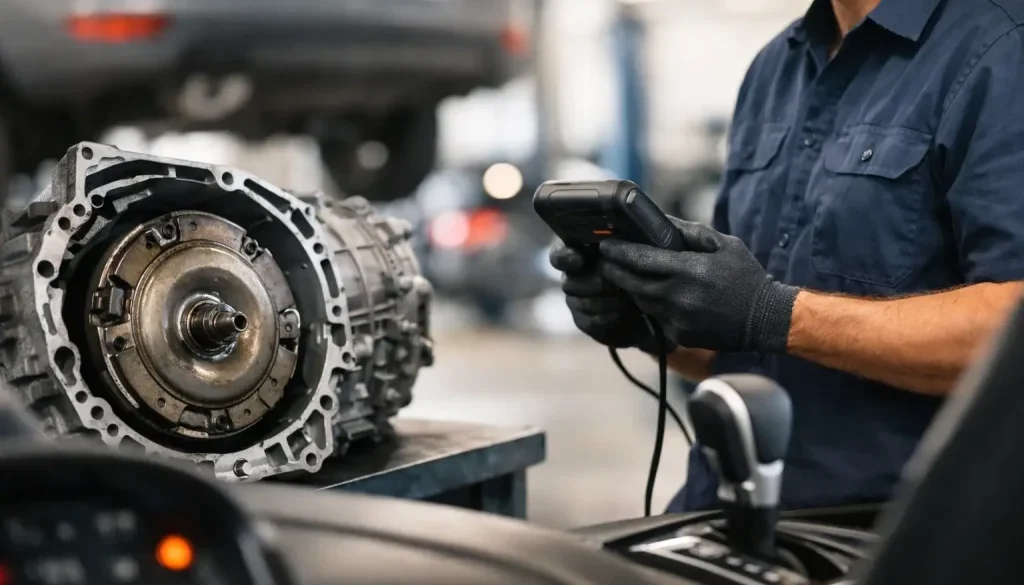
Professional diagnosis considers the complete vehicle. A technician will discuss when the concern occurs, inspect for leaks or visible issues, scan the vehicle’s control modules and assess relevant live data and fault codes. Depending on the vehicle and symptoms, further testing may be needed to check transmission operation, fluid condition, mechanical performance and related engine systems.
This careful process gives you clearer advice. It separates maintenance needs from faults requiring repair and helps ensure recommendations are suited to your vehicle, rather than based on assumptions. It also matters for European vehicles, where DSG and S-Tronic systems have specific service requirements and complex electronic controls.
The role of transmission fluid
Transmission fluid is more than a lubricant. In many automatic transmissions, it assists with cooling, hydraulic pressure and smooth clutch operation. Over time, heat, age and driving conditions can affect its condition. Stop-start traffic, short trips, towing and regular hill driving can all place added demand on the system.
A fluid and filter service may be appropriate where the transmission is operating normally but is due for maintenance, or where diagnosis confirms that fluid condition is contributing to the concern. It is not, however, a cure for every transmission fault. If there is a mechatronic issue, clutch wear, internal damage or a significant electrical problem, the correct repair needs to address that specific cause.
Automatic Transmission Repair for Modern Gearboxes
Older conventional automatics, continuously variable transmissions and modern dual-clutch units do not operate in the same way. That is why specialist knowledge and appropriate diagnostic equipment are so valuable.
A conventional automatic transmission generally uses a torque converter and a series of internal clutch packs to manage gear changes. Repairs may involve addressing fluid leaks, solenoid faults, valve body problems or internal wear. The right solution depends on the transmission design, fault findings and the vehicle’s overall condition.
DSG, DCT and S-Tronic gearboxes use two clutches to pre-select gears for fast, efficient shifts. Their operation relies heavily on the mechatronic unit, which brings electronic and hydraulic controls together. A fault may present as harsh changes, missed shifts, transmission warnings, loss of drive or the vehicle entering a reduced-performance mode.
Depending on diagnosis, a dual-clutch transmission may need servicing, adaptation work, mechatronic unit repair, clutch replacement or more extensive restoration. These systems should be assessed by technicians familiar with their particular service procedures and fault patterns. Guesswork can lead to unnecessary work and leave the original issue unresolved.
What to Expect From a Professional Assessment
Clear communication matters when a transmission concern is stressful. Before your appointment, make a note of what you have noticed: whether the issue happens when the vehicle is cold or warm, at certain speeds, during acceleration, or when selecting a particular gear. Let the workshop know if any warning lights appeared, if the issue began after another repair, or if there has been a fluid leak beneath the vehicle.
At the assessment, the technician should explain the findings in practical language. You should understand what has been identified, what work is recommended, how urgent it is and what may happen if it is left unattended. Some concerns require prompt repair to protect the transmission or maintain safe, predictable driving. Others may be monitored or addressed as part of planned maintenance.
For drivers across Ringwood and Melbourne’s eastern suburbs, Ringwood Auto Tech provides specialist automatic and DSG transmission diagnostics, servicing and repair support alongside general mechanical care. As a family-owned workshop, we treat each and every car as though it were our own, with advice focused on the safety, reliability and long-term needs of the vehicle.
When to Stop Driving and Arrange Help
If the vehicle loses drive, will not select a gear, has a strong burning smell, makes severe grinding noises or displays a transmission warning with major changes in performance, it is best not to continue driving unnecessarily. Continuing to drive through serious slipping, shuddering or harsh engagement can increase damage and may leave you stranded.
For less severe symptoms, arrange an inspection soon rather than waiting for your next routine service. A mild delay or occasional shift flare may be the first indication of an issue that is easier to manage when found early. It depends on the fault, but timely diagnosis gives you more options and greater peace of mind.
Protecting your transmission between services
Drivers do not need to diagnose or repair a gearbox themselves, but sensible habits can support transmission health. Follow the manufacturer’s service schedule, including any specified transmission fluid and filter intervals. Mention changes in driving behaviour promptly, and avoid assuming that a warning light will clear permanently because it disappears after restarting the car.
If your vehicle is used for frequent short trips, heavy traffic, school runs, carrying loads or regular travel through hilly areas, discuss your driving conditions at service time. Your technician can advise whether the standard maintenance schedule remains suitable for how the car is actually used.
A transmission should make driving feel predictable, responsive and calm. If yours is doing the opposite, a proper assessment is the practical next step. Acting early protects your confidence on the road and gives your vehicle the careful attention it deserves.


Roadworthy Certificate for Victorian Drivers - Ringwood Auto Tech
July 13, 2026 @ 6:02 pm
[…] example, an automatic or DSG transmission may operate safely enough to meet roadworthy requirements while still showing early signs that it […]
When Is an S Tronic Gearbox Service Due? - Ringwood Auto Tech
July 31, 2026 @ 12:02 pm
[…] attention if you notice repeated shuddering when taking off, harsh or delayed changes, revs rising without the expected acceleration, a clunk when selecting drive or reverse, or a […]
DSG Service Versus Automatic Service Explained - Ringwood Auto Tech
August 30, 2026 @ 6:32 pm
[…] symptoms do not automatically mean the gearbox needs major repairs. Low-speed hesitation can have more than one cause, and a warning message needs a proper scan […]
What a Drivability Diagnosis Process Reveals - Ringwood Auto Tech
October 1, 2026 @ 1:32 pm
[…] components, fuel delivery, air leaks, sensors, carbon build-up or an underlying mechanical issue. A delayed shift could be caused by a transmission concern, but it may also be influenced by engine performance, […]